Roots
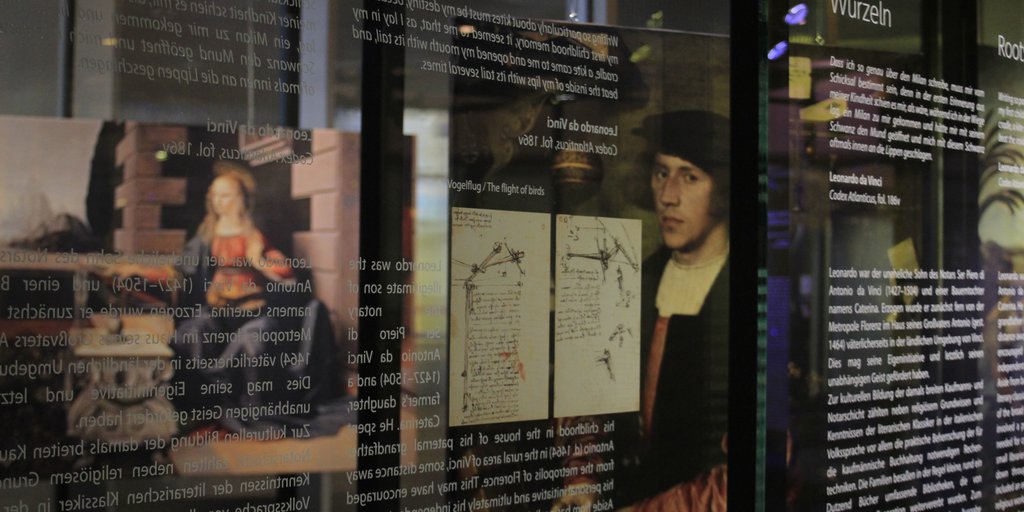
Writing so particularly about kites must be my destiny, because in my first
childhood memory, it seemed to me that, as I lay in my cradle, a kite came to me
and opened my mouth with its tail, and beat the inside of my lips with its tail
several times
Leonardo da Vinci
Codex Atlanticus, fol. 186v. Translation: Elizabeth Hughes
Leonardo was the illegitimate son of the notary Ser Piero di Antonio
da Vinci (1427–1504) and a farmer’s daughter, Caterina. He spent his childhood in
the house of his paternal grandfather Antonio (d. 1464) in the rural area of Vinci,
some distance away from the metropolis of Florence. This may have encouraged his
personal initiative and ultimately his independent spirit.
Aside from basic
religious knowledge and familiarity with the literary classics in the Italian
vernacular, the cultural education of the broad merchant and notary class at that
time mainly involved a practical mastery of the arithmetic techniques needed for
commercial accounting. Families usually owned small libraries of around a dozen
books that were passed down through the generations. The typical collection included
an edition of the Bible—often in Italian—and other religious works (collections of
acts of the saints, confessionals, psalms, and sermons) as well as the vernacular
classics of the literary triumvirate of Dante, Petrarch, and Boccaccio. An
arithmetic book (libro d’abaco) was indispensable for reference and as a textbook
for everyday mathematical tasks. Additionally, the head of the family consecutively
recorded memorable events and recollections (ricordanze) in a family album. Some
family members also tried their hand at writing edifying texts. Leonardo’s
half-brother Lorenzo (1480–1531), a wool merchant, wrote two short religious tracts.
Most of the works were still handwritten codices. Book printing was still in its
infancy when Leonard was young, but this would soon change rapidly, in Italy as
elsewhere.